

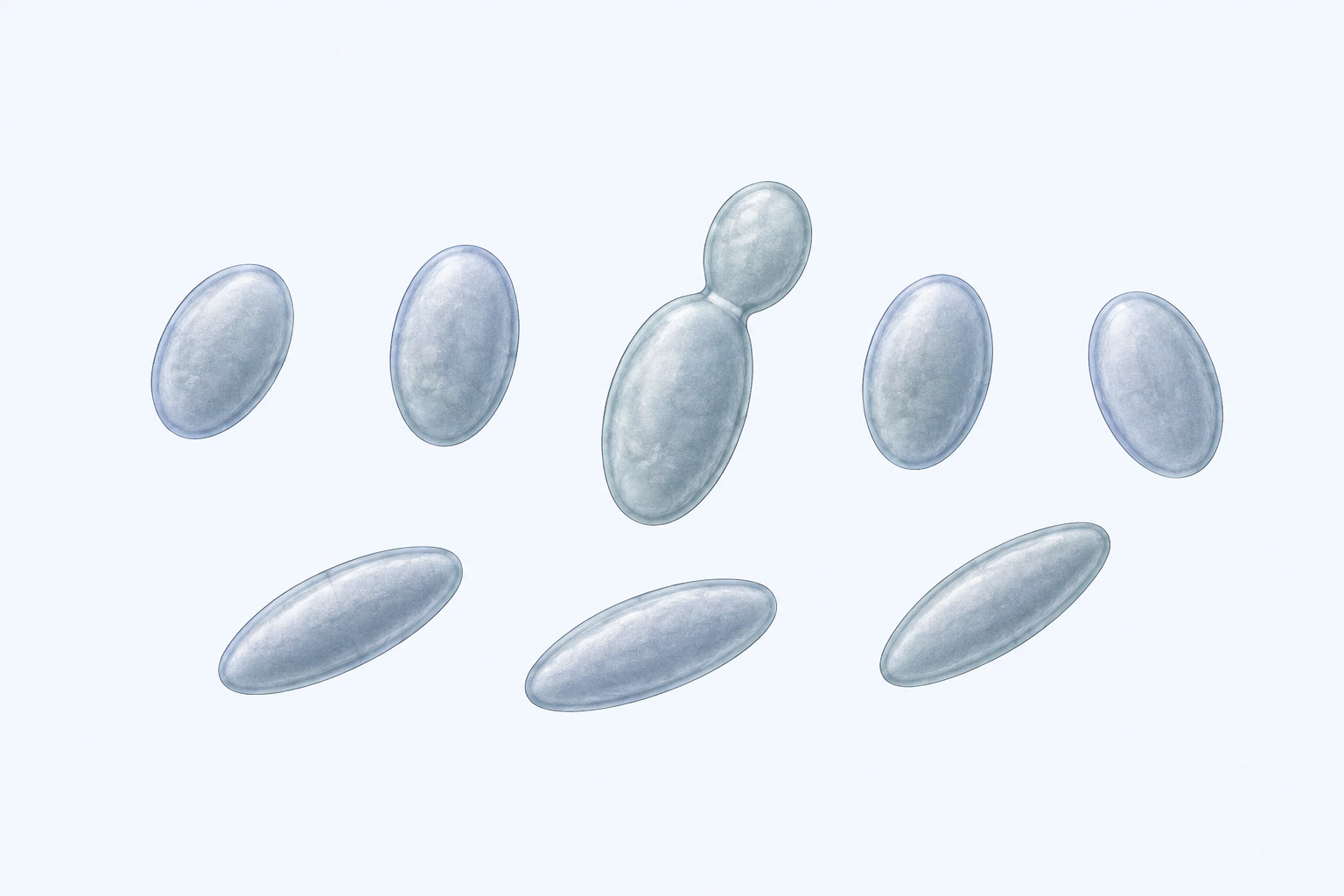
Selected Lodderomyces elongisporus morphology showing six oval-to-elongate yeast bodies in four single and one narrow-based budding-pair grouping, plus three elongated spore-like forms. This scientific reconstruction is type-material anchored, representative, non-diagnostic, not a micrograph, and makes no universal sporulation claim.
Scientific media record1 verified identifier
- Subject
- Lodderomyces elongisporustaxon · species
- Identifiers
- NCBITaxon:36914
- Review
- Editorial review completeIdentifiers authority-verified · Accessibility validated · · lodderomyces-elongisporus|lodderomyces-elongisporus-morphology-v1.webp
- Digital source
- Trained-algorithmic mediaCreated with a trained generative algorithm and reviewed by WikiBiome for subject identity, scientific framing, identifiers, provenance, and accessibility.
- Scientific basis
- Lodderomyces elongisporus — NCBI TaxonomyIndex FungorumComplete genome sequence of Lodderomyces elongisporus CBS 2605Lodderomyces elongisporus morphology and phylogenyLodderomyces elongisporus microscopy
- License
- CC BY-SA 4.0Created
Lodderomyces elongisporus is an ascomycetous yeast and the closest known phylogenetic relative of Candida parapsilosis. Originally considered non-pathogenic, it has emerged as a rare but clinically significant cause of fungemia, particularly in patients with indwelling catheters or immunosuppression. It is frequently misidentified as C. parapsilosis by conventional methods.
Metal Dependencies#
L. elongisporus shares with its Candida relatives a dependence on iron for growth, zinc for protease activity, and copper for superoxide dismutase-mediated oxidative defense. Its iron acquisition strategies likely mirror those of C. parapsilosis, including reductive iron uptake and possible siderophore utilization.
Ecological Role#
The natural ecological niche of L. elongisporus remains poorly defined. Its detection in clinical settings—bloodstream infections, catheter tips—suggests it can exploit breaches in host barriers.
Genomic analysis reveals expanded gene families for secreted aspartyl proteases and lipases, indicating adaptation for tissue invasion similar to pathogenic Candida species.
Conditions Associated#
Reported cases of L. elongisporus fungemia are rare but increasing as molecular identification methods improve. Patients with central venous catheters and prolonged ICU stays are at greatest risk. Antifungal susceptibility is generally favorable, with sensitivity to fluconazole and amphotericin B, though resistance monitoring is warranted given its emerging status.
Cross-References#
- candida-parapsilosis—closest phylogenetic relative
- Iron—growth requirement
- Biofilm—catheter-associated persistence
- Candida albicans—comparative virulence framework
References 3
Numbered by first appearance in the article, then reconciled with its declared source list.
- 1
Ling Z, Cheng Y, Lan Z et al. (2025). Gut Mycobiota Dysbiosis and Systemic Immune Dysfunction in Chinese Schizophrenia Patients with Metabolic Syndrome. Frontiers in Immunology.
- 2
Zongxin Ling, Yiwen Cheng, Zhiyong Lan et al. (2025). Ling 2025 — Gut Mycobiota Dysbiosis and Systemic Immune Dysfunction in Chinese Schizophrenia Patients with Metabolic Syndrome. Frontiers in Immunology.
- 3
Li Shuting, Dong Lili, Yang Xinlei et al. (2025). Exploratory Study on the Impact of Intestinal Fungi on Heart Failure Progression in CKD Patients. Medical Journal of Peking Union Medical College Hospital.
Article network
Mentioned here 3
Connect the evidence
Publicly readable discussion by ORCID-authenticated researchers. Questions, interpretation, methods, corrections, and new evidence stay attached to this record.
No discussion yet. Start with a precise question or a source-backed observation.
Published page changes
This record shows only material changes published on this page, including changes to its content, evidence, conclusions, or author context. Internal processes and discussion activity are excluded. Pending, declined, and withdrawn proposals remain private.
- published revision
Added references: ling-2025-gut-mycobiota-dysbiosis-immune-dysfunction-schizophrenia-metabolic-syndrome; ling-2025-gut-mycobiota-schizophrenia-metabolic-syndrome-trichosporon; li-2025-intestinal-fungi-ckd-heart-failure.
WikiBiome Deploy Bot · +8 −7
Inspect exact Git diff ↗ - published revision
Created “Lodderomyces elongisporus”: Lodderomyces elongisporus is an ascomycetous yeast and the closest known phylogenetic relative of Candida parapsilosis. Originally considered non-pathogenic, it has emerged as a rare but clinically…
Created “Lodderomyces elongisporus”: Lodderomyces elongisporus is an ascomycetous yeast and the closest known phylogenetic relative of Candida parapsilosis. Originally considered non-pathogenic, it has emerged as a rare but clinically… Published sections: Overview; Metal Dependencies; Ecological Role; Conditions Associated; Cross-References. · WikiBiome Deploy Bot · +58 −0
Inspect exact Git diff ↗