

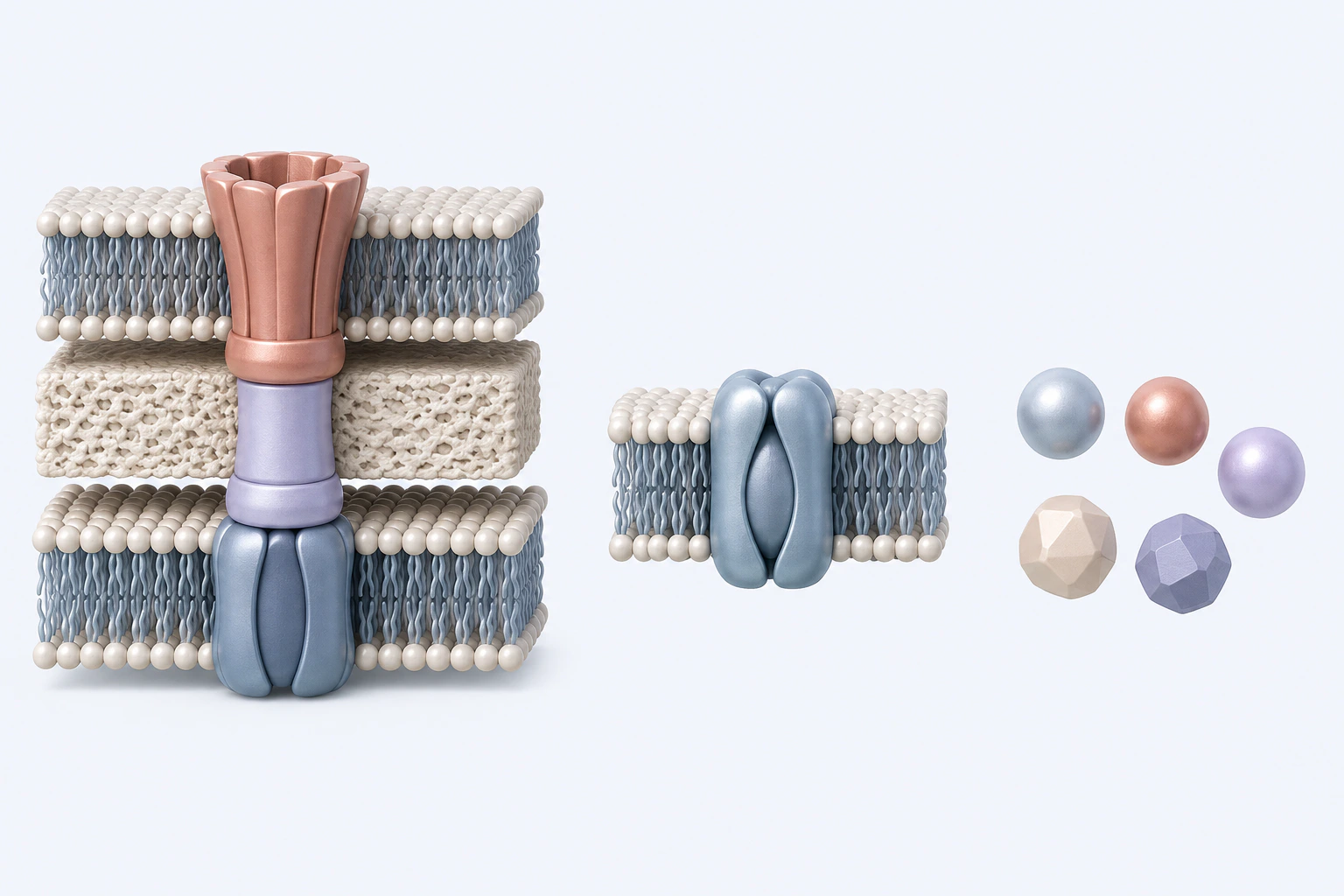
Representative efflux-pump architecture orientation. The not-to-scale teaching models do not universalize envelope type, pump composition, energy source, substrate, transport direction, resistance, pathogenicity, inhibitor response, or clinical meaning.
Scientific media record3 verified identifiers
- Subject
- Efflux Pumpsbiological-process
- Identifiers
- WikiBiome:efflux-pumpsGO:1990281GO:0015562
- Review
- Editorial review completeIdentifiers authority-verified · Accessibility validated · · efflux-pumps|efflux-pumps-mechanism-v1.webp
- Digital source
- Trained-algorithmic mediaCreated with a trained generative algorithm and reviewed by WikiBiome for subject identity, scientific framing, identifiers, provenance, and accessibility.
- Scientific basis
- Efflux pump complex — GO:1990281Efflux transmembrane transporter activity — GO:0015562Bacterial multidrug efflux pumps: much more than antibiotic resistance determinantsEfflux pumps of Gram-negative bacteriaEfflux Pumps
- License
- CC BY-SA 4.0Created
Membrane-spanning protein complexes that actively export substrates from the bacterial cell, using energy from ATP hydrolysis or the proton motive force.
In the context of metal-microbiome biology, efflux pumps serve a dual role that has profound clinical consequences: they export toxic metals to maintain Metal Homeostasis, but many of the same pumps also export antibiotics—creating cross-resistance that links environmental metal exposure directly to antimicrobial resistance.
Evidence map4 cited passagesInspect provenance +
Nies (2025) proposed that efflux pumps, not importers, are the primary determinants of intracellular metal speciation:
The most clinically consequential feature of efflux pumps: many have broad substrate ranges that encompass both metals and antibiotics:
AcrAB-TolC (RND family): The major multidrug efflux system in Gram-negative bacteria. Copper stress activates the MarR repressor, which induces AcrAB-TolC expression, creating broad-spectrum antibiotic resistance via a metal intermediate
Efflux pumps are the dominant mechanism of the cross-resistance arm of co selection:
Contents
1. Role in Metal Homeostasis2. Cross-Resistance: The Metal-Antibiotic Bridge3. Relevance to Co-Selection4. Efflux Pumps as Drug Targets5. ConnectionsRole in Metal Homeostasis#
The Flow Equilibrium Model#
Nies (2025) proposed that efflux pumps, not importers, are the primary determinants of intracellular metal speciation.[1]Nies 2025 — A Flow Equilibrium Model Controlling Cytoplasmic Transition Metal Cation Pools and Preventing Mis-MetalationDietrich H Nies, Julie A Maupin-Furlow · 2025Open reference 1 ↓
Metal importers lack specificity—most divalent transition metals are ~0.75 A diameter and enter through the same channels. Metalloregulator control efflux pump expression, adjusting export rates to maintain correct metal concentrations. Metals flow continuously through the cell: import into the Labile Metal Pool, protein binding or efflux.
The balance between import and efflux determines the steady-state labile pool concentration.
Metal-Specific Efflux Systems#
| Pump Family | Metals Exported | Energy Source | Key Examples |
|---|---|---|---|
| P-type ATPases | copper (Cu)+, zinc(II) (Zn2+), cadmium(II) (Cd2+), lead(II) (Pb2+) | ATP | CopA (copper export), ZntA (zinc/cadmium/lead export) |
| RND (Resistance-Nodulation-Division) | cobalt(II) (Co2+), zinc(II), cadmium(II), nickel(II) (Ni2+) | Proton motive force | CzcCBA (cobalt/zinc/cadmium in Ralstonia) |
| CDF (Cation Diffusion Facilitator) | zinc(II), iron(II) (Fe2+), cobalt(II), manganese(II) (Mn2+) | Proton antiport | YiiP/FieF (iron/zinc), MntP (manganese) |
| MFS (Major Facilitator Superfamily) | Various | Proton antiport | Some metal-specific members |
Cross-Resistance: The Metal-Antibiotic Bridge#
The most clinically consequential feature of efflux pumps: many have broad substrate ranges that encompass both metals and antibiotics:[2]Baker-Austin 2006 — Co-selection of Antibiotic and Metal ResistanceBaker-Austin C, Wright MS, Stepanauskas R et al. · 2006Open reference 2 ↓
Direct Cross-Resistance Examples#
CzcCBA (RND family): Expels cobalt, zinc, and cadmium—but its broad substrate range also includes certain antibiotics. Metal exposure selects for CzcCBA overexpression, conferring antibiotic resistance without any antibiotic exposure.
AcrAB-TolC (RND family): The major multidrug efflux system in Gram-negative bacteria. Copper stress activates the MarR repressor, which induces AcrAB-TolC expression, creating broad-spectrum antibiotic resistance via a metal intermediate.[3]Co-Selection of Resistance to Antibiotics, Biocides and Heavy Metals, and Its Relevance to Foodborne PathogensWales AD, Davies RH · 2015Open reference 3 ↓
TetL: Transports both tetracycline and cobalt. MexAB-OprM: The Pseudomonas aeruginosa multidrug efflux pump that also exports metals; linked to imipenem resistance through co-regulatory circuits with metal efflux operons.
The Regulatory Cascade#
Metal exposure does not always directly induce antibiotic efflux pumps. Sometimes the connection is indirect:
- Metal stress damages the cell envelope
- Envelope stress activates sigma factors or two-component systems
- These regulators induce efflux pump expression as part of a general stress response
- The induced pumps happen to also export antibiotics
This mechanism means that sub-inhibitory metal concentrations—levels too low to kill bacteria—can still drive antibiotic resistance by activating stress-response efflux systems.
Relevance to Co-Selection#
Efflux pumps are the dominant mechanism of the cross-resistance arm of Co-Selection.[2]Baker-Austin 2006 — Co-selection of Antibiotic and Metal ResistanceBaker-Austin C, Wright MS, Stepanauskas R et al. · 2006Open reference 2 ↓
Unlike co-resistance (where distinct resistance genes ride the same mobile element), cross-resistance requires no genetic linkage—a single pump does double duty. This means cross-resistance can arise in any bacterium with broad-substrate efflux pumps, without horizontal gene transfer.
Reduced outer membrane permeability (another cross-resistance mechanism selected by metals) further reduces antibiotic entry, compounding efflux-mediated resistance.
Efflux Pumps as Drug Targets#
Efflux Pump Inhibitors (EPIs)#
Blocking efflux could simultaneously resensitize bacteria to both metals and antibiotics. PAβN (phenylalanine-arginine beta-naphthylamide) inhibits RND efflux pumps. Combining EPIs with antibiotics reverses resistance in some clinical isolates.
The challenge: EPIs must be non-toxic to host cells and specific enough to avoid disrupting essential mammalian transporters.
Antimicrobial Metal Strategies#
Antimicrobial-metals exploit efflux pump limitations. Silver, copper, and zinc can overwhelm efflux capacity at sufficient concentrations. Zinc ionophores (e.g., PBT2) bypass the pump entirely by importing zinc faster than efflux can export it.
Combining metals with antibiotics can saturate efflux pumps with metal substrates, reducing antibiotic export capacity.
Connections#
- Co-Selection—efflux pumps are the primary mechanism of cross-resistance
- Metalloregulator—metalloregulators control efflux pump expression
- Labile Metal Pool—efflux pumps maintain the labile pool steady state
- Antimicrobial Resistance—efflux-mediated antibiotic resistance
- Antimicrobial Metals—metals exploit efflux capacity limitations
- Metal Homeostasis—efflux is one of the three pillars (import, storage, efflux)
- Metal Sensing—efflux pump expression is controlled by metal sensors
- Biofilm—biofilm formation can be an alternative to efflux for metal tolerance
References 3
Numbered by first appearance in the article, then reconciled with its declared source list.
- 1
Dietrich H Nies, Julie A Maupin-Furlow (2025). Nies 2025 — A Flow Equilibrium Model Controlling Cytoplasmic Transition Metal Cation Pools and Preventing Mis-Metalation. Journal of Bacteriology.
- 2
Baker-Austin C, Wright MS, Stepanauskas R et al. (2006). Baker-Austin 2006 — Co-selection of Antibiotic and Metal Resistance. Trends in Microbiology.
- 3
Wales AD, Davies RH (2015). Co-Selection of Resistance to Antibiotics, Biocides and Heavy Metals, and Its Relevance to Foodborne Pathogens. Antibiotics.
Article network
Connect the evidence
Publicly readable discussion by ORCID-authenticated researchers. Questions, interpretation, methods, corrections, and new evidence stay attached to this record.
No discussion yet. Start with a precise question or a source-backed observation.
Published page changes
This record shows only material changes published on this page, including changes to its content, evidence, conclusions, or author context. Internal processes and discussion activity are excluded. Pending, declined, and withdrawn proposals remain private.
- published revision
Created “Efflux Pumps”: Membrane-spanning protein complexes that actively export substrates from the bacterial cell, using energy from ATP hydrolysis or the proton motive force. In the context of metal-microbiome biology,…
Created “Efflux Pumps”: Membrane-spanning protein complexes that actively export substrates from the bacterial cell, using energy from ATP hydrolysis or the proton motive force. In the context of metal-microbiome biology,… Published sections: Efflux Pumps; The Flow Equilibrium Model; Metal-Specific Efflux Systems; Cross-Resistance: The Metal-Antibiotic Bridge; Direct Cross-Resistance Examples; The Regulatory Cascade; Relevance to Co-Selection; Efflux Pump Inhibitors (EPIs); Antimicrobial Metal Strategies; Connections. · WikiBiome Deploy Bot · +96 −0
Inspect exact Git diff ↗