

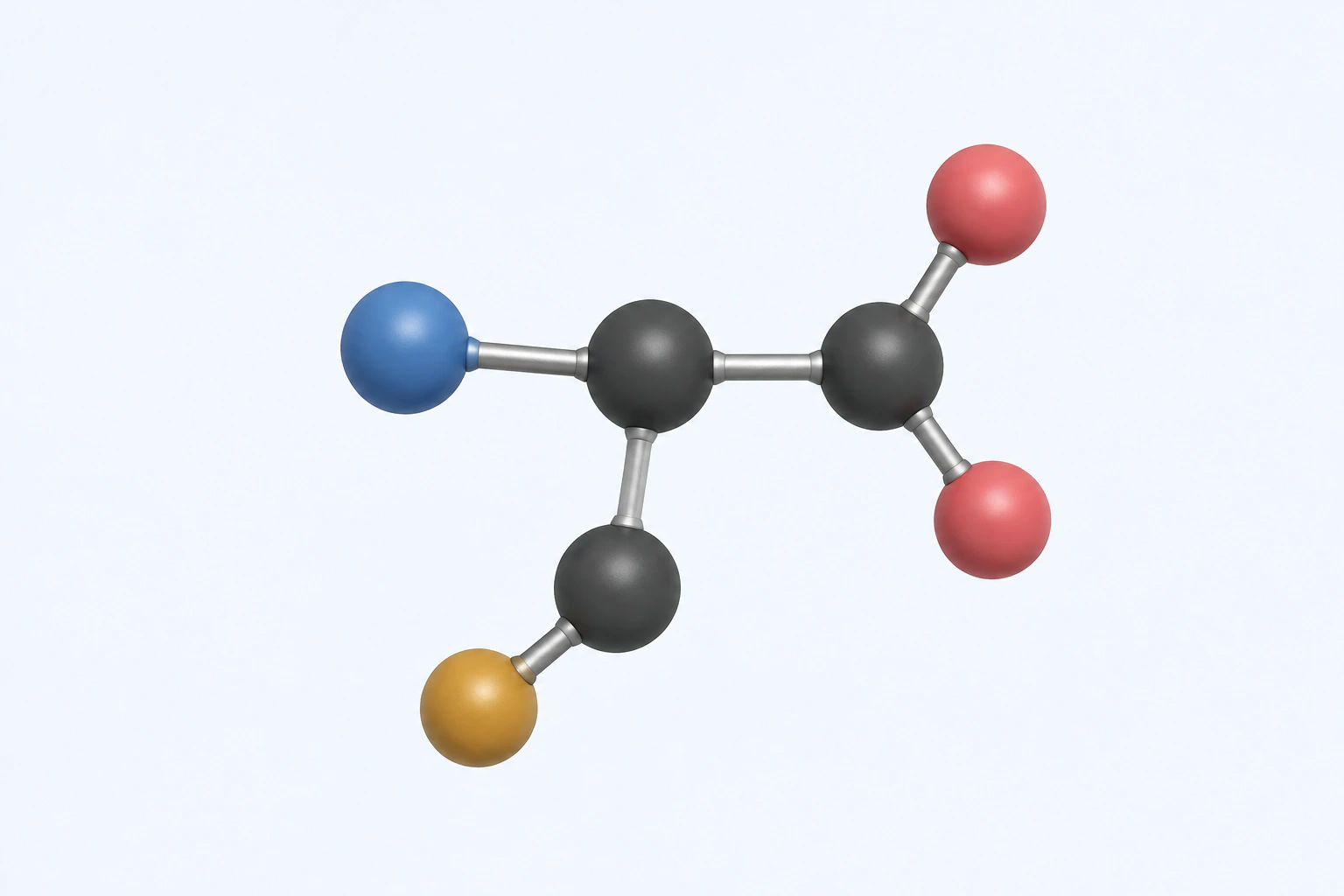
Heavy-atom connectivity orientation for L-cysteine. Hydrogens, visually proven stereochemistry, protonation state, measured conformation, metal binding, metabolic fate, concentration, and disease claims are intentionally omitted; this is an educational reconstruction.
Scientific media record5 verified identifiers
- Subject
- L-Cysteinehost-defense
- Identifiers
- WikiBiome:cysteinePubChem:5862ChEBI:17561MeSH:D003545InChIKey:XUJNEKJLAYXESH-REOHCLBHSA-N
- Review
- Editorial review completeIdentifiers authority-verified · Accessibility validated · · cysteine|cysteine-host-defense-v1.webp
- Digital source
- Trained-algorithmic mediaCreated with a trained generative algorithm and reviewed by WikiBiome for subject identity, scientific framing, identifiers, provenance, and accessibility.
- License
- CC BY-SA 4.0Created
Cysteine is a sulfur-containing amino acid whose thiol (-SH) group makes it the primary metal-binding residue in biology. It is the rate-limiting precursor for Glutathione (GSH) (the master intracellular antioxidant), a key residue in metallothioneins (metal-binding proteins), and a precursor for Hydrogen Sulfide (H₂S) (via CBS/CSE enzymes).
In the WikiBiome framework, cysteine sits at the intersection of metal detoxification, antioxidant defense, and microbial sulfur metabolism.
Evidence map3 cited passagesInspect provenance +
Cadmium, mercury, lead, arsenic all bind cysteine thiol groups with high affinity, depleting free cysteine and glutathione pools → oxidative stress.
Iron-sulfur clusters use cysteine ligands—heavy metal disruption of Fe-S clusters is a primary toxicity mechanism.
Nickel: Bacterial nickel-binding proteins (Hpn, HypB) use histidine-rich motifs, but cysteine residues are critical in nickel efflux and storage proteins.
Metal Binding#
Cadmium, mercury, lead, arsenic all bind cysteine thiol groups with high affinity, depleting free cysteine and glutathione pools → Oxidative Stress.[1]Molecular Mechanisms of Cellular Injury and Role of Toxic Heavy Metals in Chronic Kidney DiseaseManish Mishra, Larry Nichols, Aditi A. Dave et al. · 2022Open reference 1 ↓[2]Heavy Metal Pollution in the Environment and Their Toxicological Effects on HumansBriffa J, Sinagra E, Blundell R · 2020Open reference 2 ↓
Zinc-finger proteins use cysteine (and Histidine) residues to coordinate zinc—metal displacement at these sites is the basis of Mis-Metallation.
Iron-sulfur clusters use cysteine ligands—heavy metal disruption of iron (Fe)-S clusters is a primary toxicity mechanism.[3]Effects of Heavy Metals on Gut Barrier Integrity and Gut MicrobiotaSweta Ghosh, Syam P. Nukavarpu, Venkatakrishna Rao Jala · 2024Open reference 3 ↓
Nickel: Bacterial nickel-binding proteins (Hpn, HypB) use histidine-rich motifs, but cysteine residues are critical in nickel efflux and storage proteins.[4]Role of Nickel in Microbial PathogenesisRobert J. Maier, Stéphane L. Benoit · 2019Open reference 4 ↓
Microbial Context#
Gut bacteria metabolize dietary cysteine via desulfhydrase enzymes → H₂S production (Hydrogen Sulfide (H₂S)). Microbial cysteine metabolism affects the gut sulfur pool, influencing both host detoxification capacity and Desulfovibrio ecology.
Cross-References#
- Glutathione (GSH)—cysteine is the rate-limiting precursor
- Hydrogen Sulfide (H₂S)—cysteine as H₂S precursor
- Mis-Metallation—metal displacement at cysteine-coordinated sites
- Iron—iron-sulfur cluster cysteine ligands
- Cadmium—high-affinity cysteine thiol binding
- oxidative stress—cysteine depletion reduces antioxidant capacity
References 4
Numbered by first appearance in the article, then reconciled with its declared source list.
- 1
★Manish Mishra, Larry Nichols, Aditi A. Dave et al. (2022). Molecular Mechanisms of Cellular Injury and Role of Toxic Heavy Metals in Chronic Kidney Disease. International Journal of Molecular Sciences.
- 2
Briffa J, Sinagra E, Blundell R (2020). Heavy Metal Pollution in the Environment and Their Toxicological Effects on Humans. Heliyon.
- 3
★Sweta Ghosh, Syam P. Nukavarpu, Venkatakrishna Rao Jala (2024). Effects of Heavy Metals on Gut Barrier Integrity and Gut Microbiota. Microbiota and Host.
- 4
★Robert J. Maier, Stéphane L. Benoit (2019). Role of Nickel in Microbial Pathogenesis. Inorganics.
Article network
Connect the evidence
Publicly readable discussion by ORCID-authenticated researchers. Questions, interpretation, methods, corrections, and new evidence stay attached to this record.
No discussion yet. Start with a precise question or a source-backed observation.
Published page changes
This record shows only material changes published on this page, including changes to its content, evidence, conclusions, or author context. Internal processes and discussion activity are excluded. Pending, declined, and withdrawn proposals remain private.
- published revision
Created “Cysteine”: Cysteine is a sulfur-containing amino acid whose thiol (-SH) group makes it the primary metal-binding residue in biology. It is the rate-limiting precursor for glutathione (the master intracellular…
Created “Cysteine”: Cysteine is a sulfur-containing amino acid whose thiol (-SH) group makes it the primary metal-binding residue in biology. It is the rate-limiting precursor for glutathione (the master intracellular… Published sections: Overview; Metal Binding; Microbial Context; Cross-References. · WikiBiome Deploy Bot · +44 −0
Inspect exact Git diff ↗